


Welgevonden vs Madikwe vs Pilanesberg: Choosing a Malaria-Free Safari Near Johannesburg

The short version
There is a question we hear at the dinner table at Laluka more often than almost any other, usually somewhere between the main course and dessert: “We nearly booked Madikwe. Did we choose right?” We love that question, because the honest answer is not a sales pitch. If you want a Big Five safari you can reach from Johannesburg in a morning, with no anti-malarial tablets, three names come up again and again: Pilanesberg, Madikwe and Welgevonden. All three are malaria-free, all three are genuine Big Five country, and all three are far closer than the Kruger. So the real question is not whether to take tablets (you will not need them at any of them). It is what kind of safari you are after: the easy, affordable getaway; the big, remote and exclusive escape; or the quiet, private reserve that sits comfortably in between. Here is the honest version, written by a family who looked at all of them before choosing where to build a life, including where we fit in.
What all three get right
It helps to start with what these reserves share, because it is a lot. Each one is malaria-free, so there are no tablets to weigh up and nothing to worry about when travelling with young children, grandparents or while pregnant. We notice what that means in practice every week: parents arrive with a baby on a hip and none of the quiet anxiety that hangs over a Lowveld trip, and nobody spends the first evening comparing side effects. Each reserve is genuine Big Five country. And each is close to Johannesburg, somewhere between roughly two and four hours by road, which means you can leave the city after breakfast and be on a game drive that same afternoon.
So in this comparison, malaria is not the deciding factor. It is simply a given. What actually separates the three is distance, size, how busy a reserve feels, and the style of stay on offer.

The three at a glance
Pilanesberg | Madikwe | Welgevonden | |
Distance from Johannesburg | ~2.5 hours (the closest) | ~4 hours, or a short charter flight | ~3 hours / 250 km, or a 45-min light-aircraft flight |
Size | ~55,000 hectares | ~75,000 hectares (one of SA's largest) | ~40,000 hectares |
Malaria | Free | Free | Free |
Access | Public park: self-drive and day visitors welcome | Private reserve: no self-drive, no day visitors | Private reserve: no self-drive, no day visitors |
How it feels | Busy, accessible, easy | Big, remote, exclusive | Intimate, quiet, scenic |
Known for | Volcanic-crater scenery and great value | African wild dogs alongside the Big Five | Rhino conservation and the Waterberg landscape |
Stays | Everything from self-catering to lodges | Exclusive, all-inclusive lodges | Mostly exclusive, all-inclusive lodges, plus some self-catering options |
Pilanesberg: the closest and most accessible
Pilanesberg is the easy one, and that is a compliment. It sits inside the crater of a long-extinct volcano about two and a half hours from Johannesburg, which makes it the nearest of the three and a realistic day trip. As a public national park it lets you bring your own car and self-drive, welcomes day visitors, and offers a wide spread of accommodation, from self-catering rest camps to comfortable lodges. That accessibility is its real strength. It is the most affordable and the most flexible of the three, and a wonderful first taste of the African bush. Ask around a Johannesburg braai and you will find that half the table had their very first safari in Pilanesberg, often as children, and they talk about it with real affection.
The trade-off is simply that it is the busiest. A good sighting can gather a line of cars, and the freedom of self-drive means you share the roads with everyone else enjoying it. If your priorities are a short drive, an easy budget and the freedom to explore at your own pace, Pilanesberg is hard to beat.
Madikwe: big, remote and exclusive
Madikwe is the wild one. At around 75,000 hectares up near the Botswana border, it is one of the largest reserves in South Africa, and one of the few places where you have a real chance of seeing the endangered African wild dog moving alongside the Big Five. It is a private reserve, so there is no self-drive and no day traffic, and its lodges are exclusive and all-inclusive. Guests who come to us after a Madikwe trip always mention the same two things: the sense of space, and the wild dogs. Watching a pack hunt is one of the great sights in Africa, and Madikwe has earned its reputation for it honestly.
What you give up for that scale and seclusion is proximity. Madikwe is the furthest of the three, roughly four hours by road, and plenty of guests choose to fly in instead. If you want a big-wilderness feel, the romance of remoteness and a shot at wild dogs, and the longer journey does not put you off, Madikwe is superb.

Welgevonden: private and intimate, in the Waterberg
Welgevonden sits between the two, and that is rather the point of it. It is a private reserve of around 40,000 hectares in the Waterberg, part of a UNESCO biosphere, about three hours north of Johannesburg (or a 45-minute light-aircraft hop to its own airstrip). Like Madikwe, it is exclusive: no self-drive, no day visitors, no convoy of vehicles at a sighting. The reserve limits how many vehicles can share a sighting at all, so most of the time it is just you, the animals and a great deal of quiet. Unlike Madikwe, it is noticeably closer to the city, and the Waterberg gives it a landscape the other two simply do not have: mountains, gorges, high grassy plateaus and river valleys, greener and more dramatic than the flatter bushveld further north and west. There are mornings here when the mist sits in the valleys below the escarpment and the drive feels more like the Scottish Highlands with giraffes.
The reserve itself has a story worth telling. It began with a farmer who convinced his neighbours to take down their fences and give the land back to the wild, and it has been run as a conservation project ever since it was formally established in the 1990s. That heritage still shapes how the reserve feels today: it is a place managed for the animals first, with tourism fitted carefully around them, and you sense it within an hour of arriving.

The rhinos still have their horns
One thing sets Welgevonden apart even among private reserves: its rhino conservation. The reserve holds one of the largest white rhino populations of any private reserve in Africa, and it is also a sanctuary for the critically endangered black rhino, the shyer, browsing cousin you will not easily see anywhere else. Thanks to one of the more respected anti-poaching programmes around, the rhinos here still carry their full horns, which has become a genuinely rare thing to witness in the wild. Much of that protection is quietly high-tech: Welgevonden has pioneered an early-warning system, built with partners that have included IBM, MTN and Wageningen University, in which sensor-collared antelope effectively stand guard, because a herd scatters differently for a human on foot than for a lion, and the data reaches the rangers before the poachers reach the rhinos.
Here is the part we always want guests to know: all of that is paid for, in the end, by people coming on safari. Every night spent inside Welgevonden helps fund the rangers, the monitoring and the veterinary work that keep those horns where they belong. So if you have ever sat in the dust at eye level with a two-tonne white rhino wearing everything nature gave it, you did not just witness the conservation story. You funded a small piece of it, and we are genuinely grateful.

Where Laluka fits in: our family's story
We are biased, naturally, so take this in the spirit it is meant, and let us at least be openly biased. Laluka Safari Lodge is one of the small, family-run lodges inside Welgevonden, and the family in question is ours. Didier spent 37 years in Belgian banking before trading his suits for the bush. His son Simon dreamed of being a safari guide since childhood, trained as a ranger in South Africa, and somewhere along the way met Giulia, an Italian who had come for a tourism internship and never quite left. The three of us searched South Africa and beyond for the right place, found a tired old lodge in Welgevonden in 2019, and rebuilt it almost from scratch during the 2020 lockdown, keeping the original foundations and adding a sixth suite.
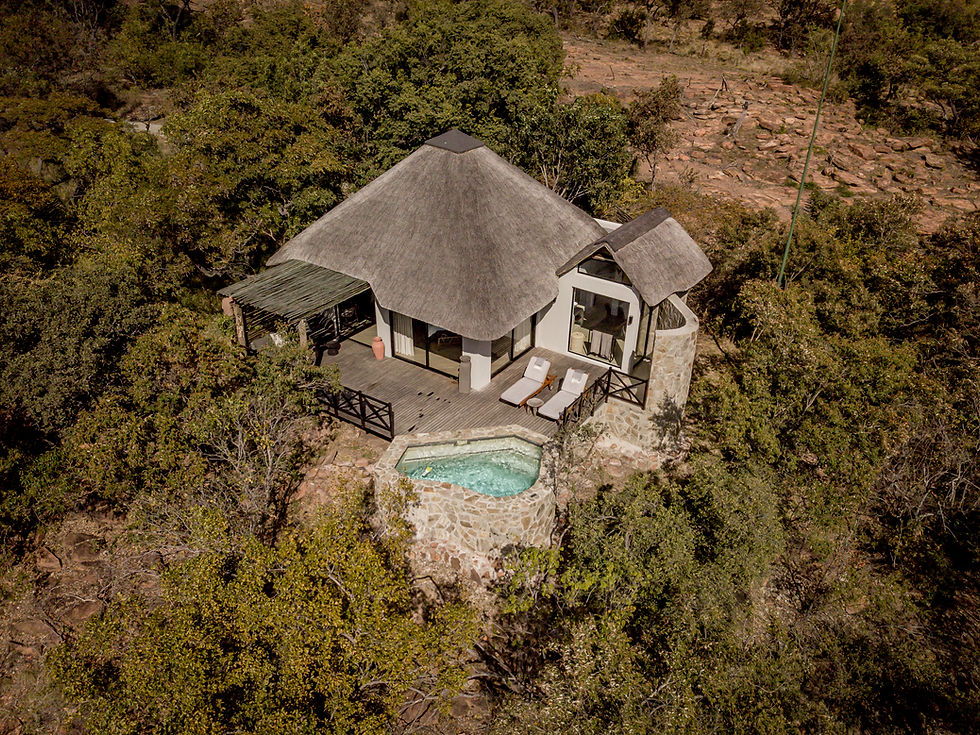
That is the other thing: Laluka is deliberately tiny, just six suites, each with its own private plunge pool looking out over the valley. That scale is the whole idea. Your guide learns your name and how you take your coffee, the day bends to you rather than to a timetable, and it never feels like a hotel. Guests regularly tell us it feels like staying with friends who happen to live in a game reserve, which is more or less exactly what is happening.

The lockdown gave us one more thing we did not plan. Stuck at the lodge, we started baking our own bread and growing vegetables, then added chickens, and before we knew it we had built a whole organic farm just outside the reserve. Today almost everything that reaches the table is farm-to-table: vegetables, eggs, honey, milk, cheese and free-range meat from our own soil, cooked in the open kitchen while you watch. And, as at the other private reserves here, a stay is all-inclusive: game drives, meals and listed drinks all sit in one nightly price, with no running tally to settle at the end (a real contrast with a self-drive park like Pilanesberg, where you assemble the day, and the costs, yourself).

None of that makes Madikwe or Pilanesberg lesser. They are excellent at being exactly what they are. It simply makes Welgevonden, and Laluka in particular, the natural choice for travellers who want private-reserve calm and a genuinely personal, home-grown stay, without driving half a day to find it.
What a day here actually looks like
Comparisons are useful, but a safari is lived in hours, not hectares, so here is an ordinary day with us. Coffee arrives before sunrise and the morning game drive rolls out around six, when the light is soft and the predators are still busy. Back at the lodge there is a long farm breakfast, and then the middle of the day is gloriously yours: the plunge pool, a bush walk with an armed ranger, a massage in the spa, or an hour in the hide, a bunker at the edge of a waterhole where you sit at eye level, mere centimetres from whatever comes down to drink. Photographers tend to disappear in there and miss lunch entirely, and we have learned to just send sandwiches.
The afternoon drive leaves around four and ends the way every safari day should: parked somewhere beautiful with a sundowner in hand while the sky performs. Dinner might be in the open kitchen, around the fire in the boma, or out in the bush under festoon lights, and because the reserve is private there is no rush back to a gate. Then you fall asleep to jackals calling and do the whole thing again. Pilanesberg and Madikwe have their own versions of the good safari day. This one is ours, and we never tire of it.

So which malaria-free reserve is right for you?
The shortest drive, the lowest cost, or the freedom to self-drive → Pilanesberg.
A big, remote, exclusive reserve with a real chance of wild dogs, and distance is no obstacle → Madikwe.
Private-reserve exclusivity close to Johannesburg, the scenery of the Waterberg, rhinos that still have their horns, and an intimate, all-inclusive, farm-to-table stay → Welgevonden, which is exactly the safari we set out to offer at Laluka.
All three will give you a malaria-free safari near Johannesburg, a genuine Big Five escape within easy reach of the city. The best one is simply the one that matches the trip you actually want. And if you are still torn at dessert, ask us then. We will give you the same honest answer.
Frequently asked questions
Which is the closest malaria-free safari near Johannesburg?
Pilanesberg is the closest, at roughly two and a half hours by road. Welgevonden is about three hours (or a 45-minute light-aircraft flight), and Madikwe is the furthest at around four hours, with many guests choosing to fly in. All three are malaria-free.
Are Welgevonden, Madikwe and Pilanesberg all malaria-free?
Yes. All three reserves sit in malaria-free regions, so no anti-malarial medication is needed, which makes them well suited to families with young children, older travellers and pregnant guests.
What is the difference between Pilanesberg and a private reserve like Welgevonden or Madikwe?
Pilanesberg is a public national park that allows self-drive and day visitors, with accommodation ranging from self-catering camps to lodges. Welgevonden and Madikwe are private reserves with no self-drive and no day visitors, where stays are typically exclusive and all-inclusive.
Which malaria-free reserve is known for rhinos that still have their horns?
Welgevonden is well known for its strong rhino-conservation and anti-poaching programme, and its rhinos still carry their full horns, which is increasingly rare to see in the wild.
Is Madikwe or Welgevonden better?
Neither is better; they suit different trips. Madikwe is larger and more remote, famous for African wild dogs, and often reached by a longer drive or a flight. Welgevonden is closer to Johannesburg, set in the mountainous Waterberg, and known for rhino conservation and intimate lodges such as Laluka Safari Lodge, with just six suites and farm-to-table dining.
What makes Laluka Safari Lodge different from other Welgevonden lodges?
Laluka is a small, family-run lodge with only six suites, an all-inclusive nightly rate covering game drives, meals and listed drinks, and a farm-to-table kitchen that sources much of its food from its own organic farm.

Comments