


When Safari Becomes Conservation: Witnessing Wildlife Interventions at Laluka

There are moments on safari that stay with you because they are beautiful. And then there are moments that stay with you because they are humbling.
Wildlife interventions fall into the second category.
Together with Dr. Peter Caldwell, the Welgevonden Game Reserve management team, and the reserve’s conservation team, we recently assisted in three animal interventions involving two white rhinos and one elephant. Each intervention was different, but all of them carried the same weight: the quiet responsibility that comes with caring for a wild place.
Three Interventions, Three Stories
The first intervention involved a young white rhino calf. Calm and unaware of the attention it was about to receive, the calf was ear-notched for identification — an essential step in long-term monitoring and protection.
Each rhino on the reserve carries a unique notching pattern, allowing conservation teams to identify individuals quickly and accurately in the field. This makes it possible to track movements, monitor health, and respond effectively when concerns arise.

At the same time, DNA samples were collected and added to a secure database. This information plays a critical role in anti-poaching efforts. Should a rhino ever be killed illegally and a horn recovered, the DNA can be matched back to the individual animal, strengthening investigations and prosecutions. Watching this process unfold was a sobering reminder that conservation today extends far beyond the moment — it is about building protection that lasts.
The second rhino was a large, battle-scarred bull. Deep fighting wounds ran beneath his neck and along his legs, injuries sustained during clashes with other bulls. Dr. Caldwell carefully treated the wounds and administered antibiotics to prevent infection. Watching this old warrior receive care was a reminder that survival in the wild often comes at a cost — and that timely intervention can make the difference between recovery and decline.
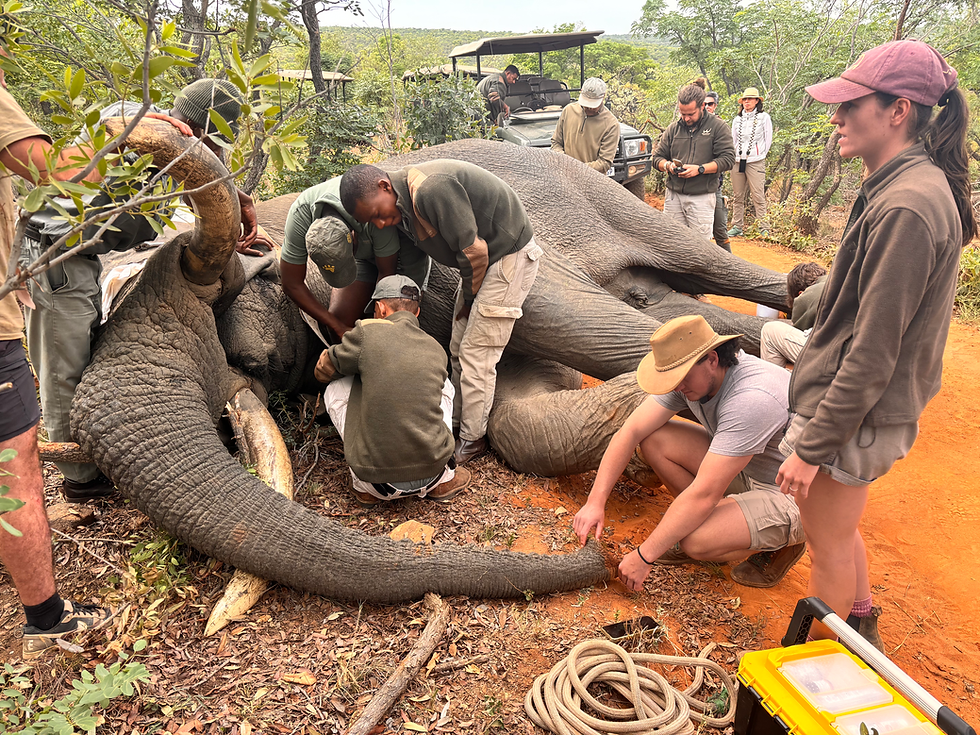
The most emotional intervention, however, involved an elephant bull close to the lodge.
This was the same bull that regularly visited Laluka’s hide. Guests were the first to notice that something was wrong — a subtle limp, a stiffness that didn’t belong. After reporting it to reserve management, the veterinary and conservation teams mobilised quickly. The very next day, the intervention took place just outside the lodge.
Standing nearby as the vet cleaned and treated wounds likely caused by clashes with other bulls was both sobering and inspiring. To see such a massive animal rendered vulnerable, then carefully helped and returned to the wild, is not something you forget easily.
How Wildlife Interventions Work
Wildlife interventions on Welgevonden are not planned far in advance. The bush does not work on fixed schedules, and neither does conservation.
Some interventions are urgent — injuries, snare wounds, sudden illness. Others are essential but less time-critical, such as rhino notching or replacing tracking collars on species like cheetah, lion, hyena, or elephant. Many of these interventions depend on funding, and this is where guest contributions can make a meaningful difference by allowing important work to happen sooner rather than later.
When guests choose to sponsor a wildlife intervention, they are contributing directly to conservation efforts on the reserve. While it is never possible to guarantee which animal or intervention will take place — circumstances change quickly, animals may move, or a more urgent case may arise — the support itself is invaluable.

The Morning of an Intervention
Interventions usually take place early in the morning. Guests and guides meet the reserve’s intervention team at a pre-arranged location close to where the procedure will happen.
The team typically includes:
Dr. Peter Caldwell, the reserve veterinarian
Armstrong, Welgevonden’s conservation manager
Thuto, the reserve’s compliance and assistant conservation manager
Conservation students completing their practical training
Armed Welgevonden Rangers for safety
A helicopter and experienced pilot
Before anything begins, there is a short briefing. Armstrong and Dr. Caldwell explain what will happen, what to expect, and how the process will unfold. Guests can ask a few questions, but most discussions are saved for later — once the animal is safe.

Dr. Caldwell then takes off in the helicopter to locate and tranquillise the animal. Once the animal is down and the area declared secure, guests are invited to approach on foot.
This is the moment that changes how people see wildlife.
Up close, the scale of the animal is overwhelming. Guests can observe the veterinary work in silence — sometimes hearing explanations, sometimes assisting with small tasks — while the conservation team works efficiently and calmly. There is no rush, no unnecessary movement. Everything is focused on the animal’s wellbeing.
Once the procedure is complete, everyone steps back. The vet reverses the anaesthesia, and the animal slowly regains consciousness. The team remains nearby, watching carefully until it is clear the animal is stable and able to move off safely.
Only then does the group leave the scene.
A short distance away, drinks and snacks are shared, and a proper debrief follows. Dr. Caldwell and Armstrong answer questions, explain decisions that were made, and discuss broader conservation challenges on the reserve. By then, the morning has slipped away, and it is time to return to the lodge for a well-earned breakfast.
More Than a Sighting

For both guides and guests, these experiences leave a deep impression.
They remind us that safari is not only about sightings, photographs, or rare moments of beauty. It is also about responsibility — about noticing when something is wrong, acting when help is needed, and supporting the systems that protect this landscape.
Welgevonden Game Reserve and Laluka Safari Lodge are deeply grateful to the guests who choose to sponsor wildlife interventions. Their contributions directly support conservation efforts and help ensure that when animals need care, help can arrive in time.
Witnessing an intervention does not feel like an activity.It feels like being entrusted, briefly, with the reality of conservation — and with the understanding that protecting wildlife sometimes means stepping in, so that the wild can continue to exist on its own terms.


Comments